
Almost every factory already has CCTV. It is watched after something goes wrong — a theft, an accident, an argument about who was where. The rest of the time it records over itself.
Netra AI runs on those same cameras and turns them into an operations monitoring system. It watches your machines and tells you when one stops, counts what comes off the line, and sends that to a phone on WhatsApp. No new hardware, no PLCs, no sensors, no wiring. If a camera can see the machine, we can usually monitor it.
Your cameras already see the problem
A plant manager can tell you, roughly, that machines stop more than they should. What almost nobody has is a number. There is no controller feed, no sensor on the line, no log. Downtime gets discovered at the end of the shift, or the end of the month, when the output does not match what everyone expected.
Meanwhile a camera has been pointed at the machine the whole time.
How it works
Three steps, and only the first one needs anything from you.
- Connect to your camera stream. We work with the DVR or NVR you already have. Most brands, most models, including older units.
- The AI watches, continuously. We mark the area of the frame that matters — the machine, the output chute, the doorway — and the system watches only that.
- You get an alert. A stop goes to WhatsApp, to whoever should know. Daily and weekly summaries follow, so the pattern is visible and not just the incident.
What it can detect
- Machine stop detection. The machine has stopped producing and nobody has noticed yet.
- Production counting. Bags, boxes, or finished pieces counted as they move, instead of tallied by hand.
- Worker attendance. Presence recorded from the camera, without a register or a punch machine.
- Smoke and fire. An early warning on an unattended floor, at night or over a holiday.
The first two are what most factories start with, because that is where the money is.
No new hardware. Really.
This is the part people do not believe, so to be specific: we take a video stream from the recorder already installed in your office. We do not touch the machine. We do not tap the control panel. We do not need your PLC, and it does not matter if the machine is forty years old and has no electronics in it at all. The machine does not know we are there.
That is the whole reason this is affordable. The cameras are a sunk cost you already paid.
What this looks like on a steel plant floor
Here is a real frame from a steel plant we monitor. The green outline is the region the system is watching — in this case a wire coil on a drawing machine. Motion inside that outline means the machine is running. No motion, for long enough, means it has stopped and somebody should know.
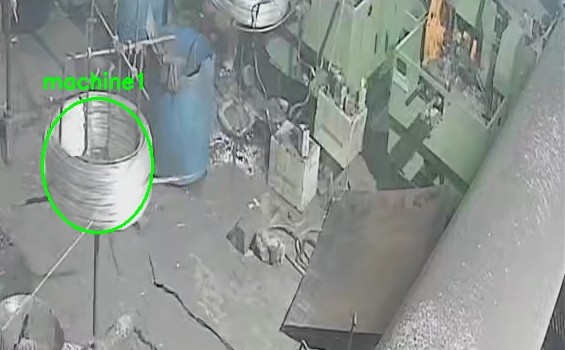
Nothing about that image is unusual. It is an ordinary security camera, mounted years ago, at an awkward angle, in bad light, looking at a dirty floor. That is the normal case, and the system is built for the normal case rather than for a clean demo.
Across three weeks on that floor, it recorded over 1,700 separate machine stops — a downtime record the plant simply did not have before. What those numbers mean, and how the plant's day actually breaks down, is a longer story for its own post.
Where this is worth your time
If you run a plant where machines stop and nobody finds out for twenty minutes, the cameras to fix that are probably already on your walls. The work is in the software, not the hardware, and that is a much cheaper problem to solve.